

Biscuitville Store Concept
There are very few truly authentic originals in the Breakfast QSR market. Biscuitville can certainly make a credible claim. As a home grown purveyor of classic handmade biscuits in North Caroline and southern Virginia, Biscuitville is the real thing, offering a taste usually reserved for your grandmother’s kitchen.
-
Biscuitville is a family-owned American regional fast-food restaurant chain. The restaurant specializes in the traditional southern breakfast made from scratch and with local ingredients.[1] The chain primarily operates in the Southeastern United States and as of February 2024, there were 82 locations in the U.S. states of North Carolina, South Carolina and Virginia.
The company, originally named Mountainbrook Fresh Bread & Milk (eventually known as Pizzaville), started as two bread stores in Burlington, NC. The founder, Maurice Jennings, began making pizzas, and soon wanted a way to put the business to work in the morning. He began making biscuits, from a recipe developed by the Jennings family. Eventually the company sold more biscuits than pizzas. The company opened its first biscuit-only operation named "Biscuitville" in 1975, located in Danville, Virginia.
-
As a local family business in an increasingly competitive marketplace crowded by multinational players, Biscuitville sought to give it’s claim to Southern Cuisine a new modern environment that balanced its heritage and credibility with the need to stay relevant with modern consumers.
Some 85% of Biscuitville customers engage with the brand via the drive thru window. In some ways, this is a positive. Regardless, the company felt the need to reimagine their stores with the objective of creating a destination not unlike Starbucks and older Panera stores — but with a Southern accent.
A contingent of retirees already made Biscuitville a regular gathering place. The brand hoped to expand this to younger demographics.
-
As the Design Office of John Murph developed a design strategy, we wanted to capitalize on the recent trend chasing the example set by Starbucks, of creating a space customers want to linger in. At a closer look, even McDonalds has overhauled their interiors to be more attractive.
As one might imagine, vintage Southern culture boasts a wealth of archetypal influences from which to draw inspiration. From the architectural "hug" that the South's signature front porch offers, to light blue ceilings originally designed to scare away "haints," to high ceilings populated to perpetually spinning fans, there was plenty of material to work with. Our objective was to create an environment that captured the best of Southern charm in three dimensions. A space that effectively did this would naturally attract visitors to sit a spell.
Despite the nostalgic focus, this environment would ideally include the latest amenities for modern culture. Butcher block table tops designed to invoke the 1930's would include USB ports that professionals could plug into as they work away from the office. Seating options would include more plush, cushioned options. We wanted to enable and ease Biscuitville's candidacy as a multi-purpose gathering place.
With any solution we explored, we wanted to avoid interior solutions with mass produced, uniform seating options. The best examples of QSR interiors offer a variety of seating options, ranging from high top cocktail tables to booths to dining tables big enough for a family of 6 or more. This variability would add to the appeal of the environment, and offer visitors choices designed to accommodate many different occasions.
-
We offered concepts that sought to leverage what constitutes quintessentially Southern architecture, from warm, inviting front porches and pitter-patter tin roofs to classic wainscoting and plantation shutters.
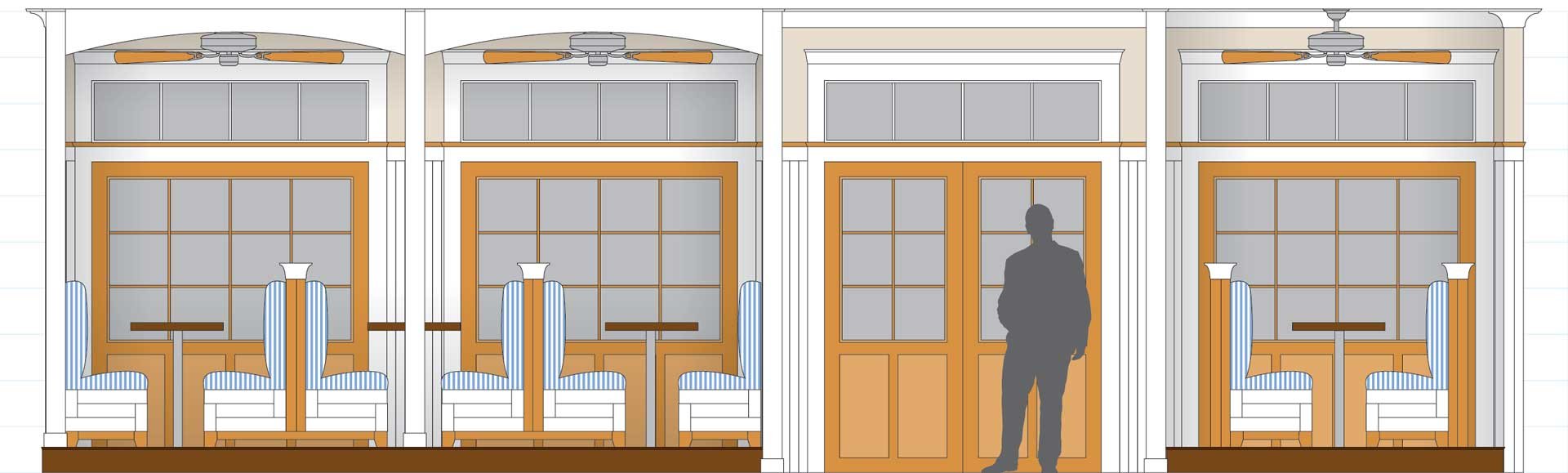
As for the interior, a new paradigm was proposed that divided the dining area into individualized spaces. This countered Biscuitville's typical cafeteria-style seating, in which uniform, mass-produced booths were packed in as tightly as possible. Instead, a variety of dining configurations were offered to suit the customer's purpose and provide a sense of privacy, leveraging the Starbucks "third space" principle.
This ranged from a 6-top family style dining table to comfortable booths upholstered in seersucker fabric to a cozy pair of lounge chairs by a fireplace. Throughout the dining room, spaces were often distinguished by a screen of plantation-style shutters. The design aesthetic was rounded out with distressed brick, ceiling fans, stamped tin tiles, and classic patterns like gingham and seersucker. The result was a destination even your Southern Belle grandmother could love.
Concepts for the exterior ranged from a classic country farmhouse motif (complete with a simulated wrap-around porch) to an homage to the South's love of renovation – mimicking a heritage brick & mortar, stained glass classic reclaimed for modern use.
-
One of the feature highlights of the store concept was the Biscuit Preparation Theater. A novelty of older Biscuitville stores was a work station for the staff to make biscuits for the production line. Over time this station had been positioned by a large window in response to customers' curiosity about it. In a context where most QSR food is frozen and pre-packaged, seeing biscuits made from scratch is a true marvel.
The Design Office of John Murph presented concepts to greatly enhance this feature, shifting the ordering counter line outward in an octagonal configuration to penetrate the customer's space and demand attention. This USP, characterizing to Biscuitville along among its competitors, needed to be front and center for all to see.
As customers waited to place their orders or have them fulfilled, they could enjoy watching staff members roll the dough and cut out biscuits. It's frankly mesmerizing.
-
While our store design concept was not directly implemented, many of the ideas and concepts presented were integrated into Biscuitville's ultimate solution. This includes the metal roofing, bright interiors, an enhanced biscuit prep theatre, and white board & batten walls.
Brand Strategy | Retail Environment Architecture & Design

As a local family business in an increasingly competitive marketplace crowded by multinational players, Biscuitville sought to give it’s claim to Southern Cuisine a new modern environment that balanced its heritage and credibility with the need to stay relevant with modern consumers.


We offered concepts that sought to leverage what constitutes quintessentially Southern architecture, from warm, inviting front porches and pitter-patter tin roofs to classic wainscoting and plantation shutters.
As for the interior, a new paradigm was proposed that divided the dining area into individualized spaces. This countered Biscuitville's typical cafeteria-style seating, in which uniform, mass-produced booths were packed in as tightly as possible. Instead, a variety of dining configurations were offered to suit the customer's purpose and provide a sense of privacy, leveraging the Starbucks "third space" principle.


This ranged from a 6-top family style dining table circled by mismatched vintage chairs, to comfortable booths upholstered in soft seersucker fabric, to a cozy pair of lounge chairs by a fireplace. Throughout the dining room, spaces were often distinguished by a screen of plantation-style shutters.
The design aesthetic was rounded out with distressed brick, ceiling fans, stamped tin tiles, and classic patterns like gingham and seersucker. The result was a destination even your Southern Belle grandmother could love.



Concepts for the exterior ranged from a classic country farmhouse motif (complete with a simulated wrap-around porch) to an homage to the South's love of renovation – mimicking a heritage brick & mortar, stained glass classic reclaimed for modern use.

