

The Phil Hanes Memorial
The Hanesbrands Theatre was built as the first of three multi-function theatres on the The Arts Council of Winston-Salem's campus. A brightly lit corridor running behind the seating features a mural commemorating the vast contributions of Philip Hanes, scion of one of Winston's most prominent families and tireless patron of local arts.
-
Philip Hanes was a stalwart benefactor of the arts in Winston-Salem throughout his lifetime, helping to position his home town as a “City of the Arts” over several decades. As a measure of gratitude for his work, The Arts Council commissioned a commemorative display recounting his dedication.
-
Still under construction at the time, the hallway identified by the Council offered a 20 foot span. The challenge was to create a graphic that was equally compelling and informative. It would be visible from the street running in front of the theatre.
-
Rather than compose a bookish timeline that carefully traced Mr. Hanes's lifespan, we planned to develop a design that departed from the expected. While there was no specific brand informing the conceptual development, the chosen paint color of the surrounding walls provided a baseline context for the exploratory.
-
The resulting design eschewed a conventional timeline reconstruction, instead highlighting a gerund-driven retrospective of his contributions. Major events and milestones in his life of service segment a monumental portrait, and offer snapshots of Hane's record advocating for the Winston-Salem arts community. As fate would have it, he died shortly after this piece was installed.
-
The milestone segments featured in the mural design were drawn from actual vintage photos of Phil Hanes's life. This included snapshots of him meeting with LBJ, strong-arming Joseph Hirshhorn (namesake of the Hirshhorn National Art Museum in DC), and strategizing with Terry Sanford, former governor of NC.
-
Mr. Hanes was able to see the completed mural at the grand opening of the Theatre and was deeply moved. He died less than a month later.
Brand Strategy | Exhibition Design
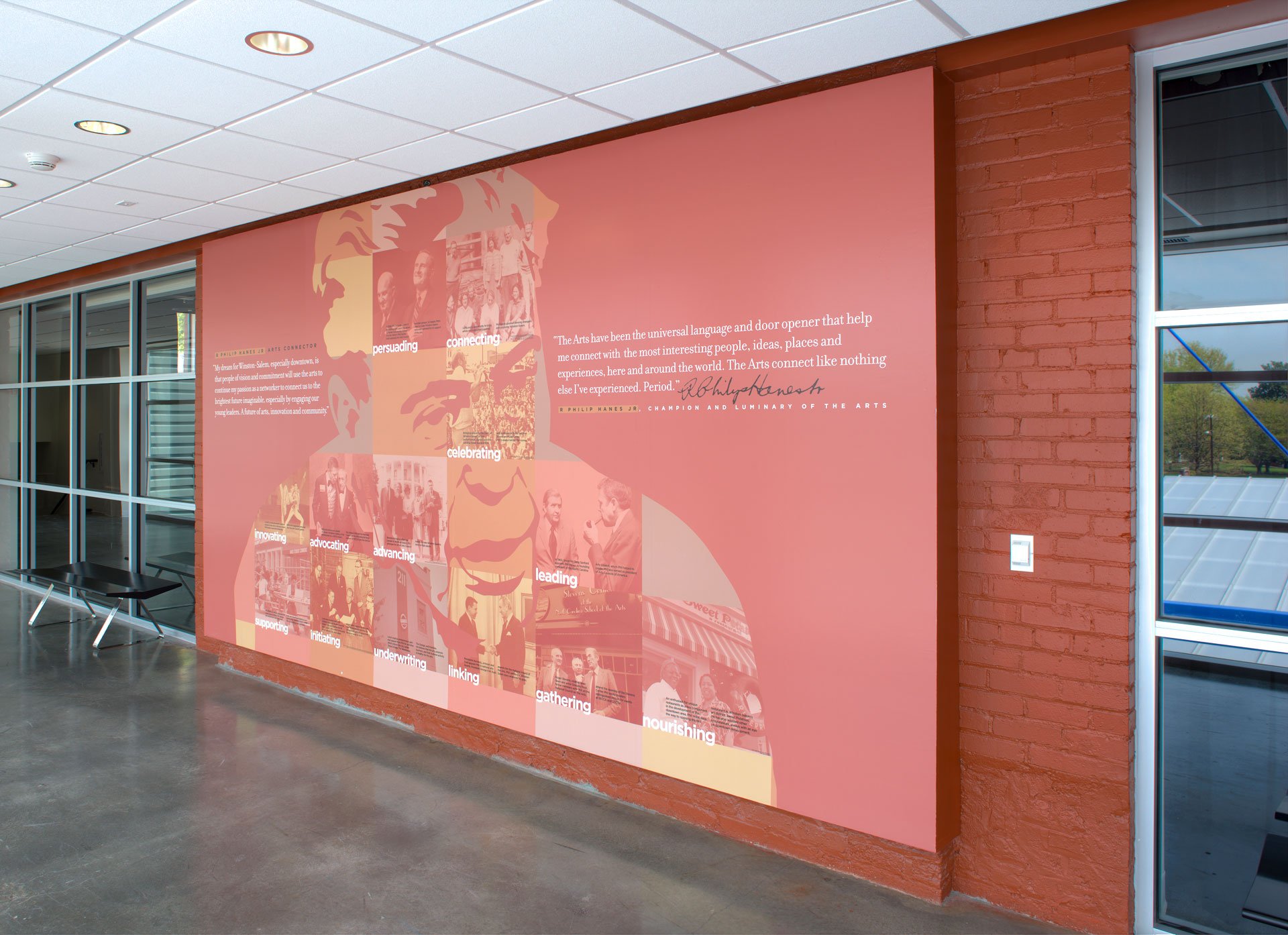


The resulting design eschewed a conventional timeline reconstruction, instead highlighting a gerund-driven retrospective of his contributions.
